


Weekly report 8
Sarah: Back to the Theory
Week nine. We are into the final stages of the process now and making progress towards the final piece.
This week we have been able to show some work to Sam and Jo, and also to the other supervisors and our peers in our final group sharing session before the exam. The main questions that have come out of this for us has been:
How do we make the complexities of our enquiry explicit within the work we are producing?
How do we reference all of our research and reading within the piece?
We are very aware that the work we have produced so far needs to have more reference within it to our wider research. I believe Sonia and I are both very clear as to what we want to say but so far the piece we have created scratches the surface of this. For the work to reflect our lines of enquiry we need to have the complexity and depth of the themes running throughout the work.
We Should all be Feminists
I have gone back to the very beginning of the process and the first book I read:
“We should all be feminists”, Chimamanda Ngozi Adichie.

This book is littered with quotes that would be interesting to use within the performance as wider references. Some examples below:
“If we do something over and over again, it becomes normal. IF we see the same thing over and over again, it becomes normal.”
“Wangri Maathai put it simply and well when she said, ‘The higher you go, the fewer women there are.’”
“A man is as likely as a woman to be intelligent, innovative, creative. We have evolved. But our ideas of gender have not evolved very much.”
“We say to girls, ‘You can have ambition, but not too much. You should aim to be successful but not too successful, otherwise you will threaten the man’”.
“Culture does not make people. People make culture”.
(Adichie, n.d.)
The above quotes are some examples of other references and acknowledgements we wish to include within our piece.
We need to acknowledge the voices of the people who oppose the accepted ‘norms’ of society.
We need to show an understanding that this is not just a surface level issue based on anxiety and beauty.
We need to show that we are aware of the complexity of the issues we are digging into.
We need to do all of this and more whilst at the same time keeping the piece true to our intentions for it – to entertain and inform.
HOW??
Possibilities to enable us to include and reference our wider research
Use recorded voice during our "mask cutting" section. to play quotes that have been of interest in our wider research.
Play with the idea of a performative lecture and give the audience the ‘facts and figures’ that we have uncovered during our process. This would create a formality to our findings.
Use the ritual of un-pegging the masks from the line - unpeg the women who have the strongest voices and views against societies pressures. Repeat this process throughout the performance. Or – take them off gradually so that by the end of the piece they have all gone and we are left only with the ‘beautiful people'.
Use recorded sound to create a soundscape of different podcast we have listened to.
This will be out primary focus this week as we know this is imperative to the success of the final outcome.
Other observations and comments regarding the performance
We need to ensure that the style of the piece is clear – it currently feels quite confused. We were aware of this and had wanted to finish the script first. We will now work in studio this week to experiment and finalise the style we want to perform in.
We do not want the dialogue to feel ‘bolted-on’. I am edging more towards the feeling of a series of ‘lab experiments’ that transition one into the next with no explanation needed. As Sonia keeps telling me “We don’t need to explain everything to the audience – they can think for themselves!”
When we go to the recording studio on Monday we need to ensure that we take our time and slow down the recordings for the first scene – when I am putting on the make-up I need to have a stronger connection to the audience which should be achieved through more eye contact and glances towards them when I am applying the make-up. Currently we are not able to play with this as the recording is too fast.
Play with the idea of using a script in hand – we are playing out a series of scenes for you, the audience. Make the audience aware that we are presenting some characters and some opinions for them to observe and form thoughts on.
Reading and Reference
An example above of one of the women we may use for our wider context to be considered during the performance.

Another example of how we can include and reference the wider context and arguments. Sonia and myself are both aware that we come to the table from a white, European background. We do not and will not understand or experience what it is to come to the themes we are exploring as a woman of colour. We understand this and need to make reference and clarity to this.
We will spend time this week ensuring that we are able to include more complexities into the piece through wider source material.
bibliography
Adichie, C. N., n.d. We should all be feminists. 1 ed. London: Fourth Estate.
Ballou, H., 2013. PrettyFunny: Manifesting a normatively sexy female comic body. Comedy Studies, 4(2), pp. 179-187.
Beckett, S., 2010. Happy days. Main edition ed. London: Faber & Faber.
Ellemers, N., 2017. Gender Stereotypes, Utrecht: Annual Reviews.
Morry, M. M., 2001. Magazine Exposure: Internalization, Self-Objectification, Eating Attitudes, and Body Satisfaction in Male and Female University Students.. Canadian Journal of Behavioural Science, 33(4), pp. 269-279.
Reel, J., 2008. Age before beauty: an exploration of body image in African-American and Caucasian adult women. Journal of Gender Studies , 17(4), pp. 321-330.
SONIA - Copy - paste and feedbacks
We are almost there!
It’s amazing to see the final shape of the performance appearing in front of our eyes but then there are still so many details that are being questioned and I wonder if the message is passing through… Nevertheless, excitement is definitely in order!
Late nights in the studio…
The transition between scene 1 and 2 is not perfect (yet!) but the parameters are there. The transition between scene 2 and 3 on the other hand… Sarah and I were looking at each other… Our expressions were saying: “I know what I want to say, I just don’t know how to!” (The usual problem!) I suggested that we should attach each other by point out the other’s insecurities. The idea was not bad but I didn’t like the result. Furthermore we already do that (a bit more indirectly) throughout the scene, so this kind of repetition would be very hypocritical of me since I kept telling Sarah that we were explaining things too much!
Monday night I was in studio reading the end of scene 2 over and over again and asking the script: “What am I going to do with you?!” Geraldo (who I asked to come, to have a discussion about the light design) didn’t answer for the script but definitely helped me to realise something.

I came to the conclusion that both (Sarah and Sonia’s) insecurities, procedures, behaviours and even ideas, try to achieve the same end goal: perfection! The idea of the “good woman” (Lafrance 2009: 85), whose main attribute is to be perfect, is present throughout the entire performance.
Why is perfection celebrated?
For some (stupid!) reason I knew this was an important question but instead of using it, I decided to imbedded it in the 10 beauty commandments, since they represent the “images of femininity so widely celebrated as perfection” (Lafrance 2009: 186) which keeps leading women towards the mountain top of the unreachable ideal, throughout the valley of inadequacy!
We keep focusing on the meaning of perfection and how we can reach it but my question is why? Why do we try so hard to achieve perfection?
I obviously don’t know the answer but, since our performance is an exposition (critical and satiric at some points but mainly an exposition) of insecurities, behaviours and ideas, I feel that, that is the ultimate question…
Sarah and Sonia are going out tonight …
We structured our play to go from the intimacy of our thoughts (scene 1) towards Sarah trying to help Sonia with her anxiety and then Sonia questioning Sarah’s ideas of beauty (scene 2). Trying so hard to achieve perfection will lead us into the choreography part (scene 3), in which we explore:
Repetitive movements;
Stopping and holding each other;
Taring the masks apart;
This will culminate in a messy, claustrophobic but also reassuring circle of clothes, tared faces and measuring tapes around us.
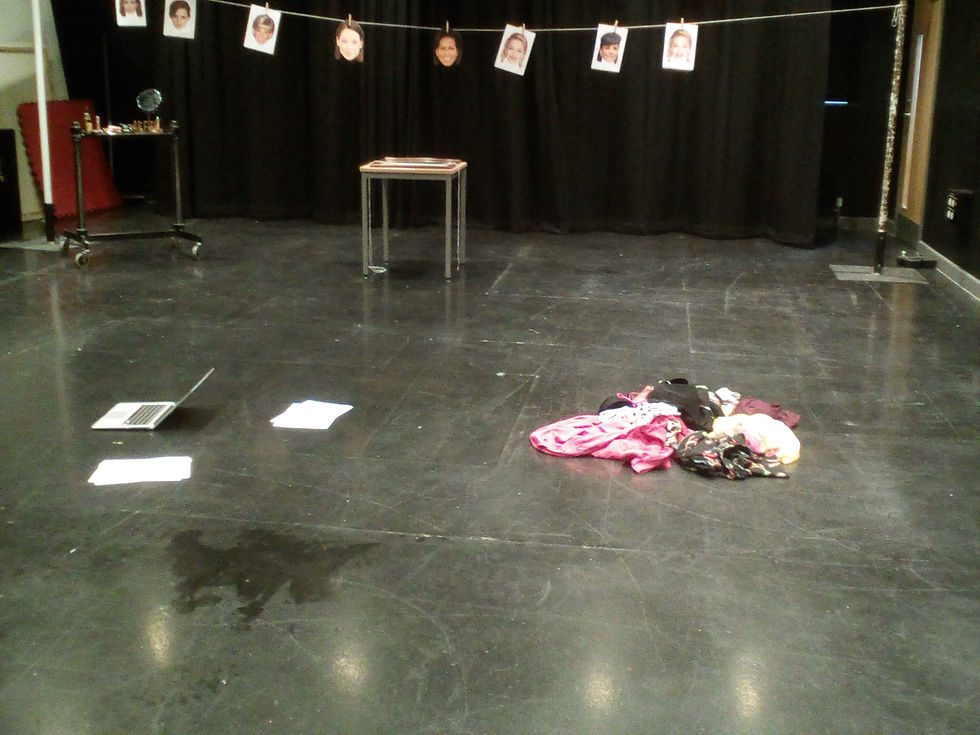
We believe this structure exemplifies “the cycle” idea we have been going on about for weeks! Also concepts as repetition, “the mask” (putting it on, criticising it and removing it), procedures and perfection, are present in each scene. Therefore we can say there are many cycles within THE cycle (the entire performance). For example, in scene 1 we expose our thoughts to the audience. It creates an intimate moment but it also expose the repetition of “the buzzing” (Beckett 2006: 380) crazy thoughts. We obviously didn’t write the scene as amazingly (or frenetically) as Beckett did in Not I and Happy Days but both plays show this fast paced, crazy spiral of thoughts. You’re trapped inside your mind and there is no way out which I relate to quest to achieve perfection.
Feedback… how to incorporate it?
This week we showed Sam what we had so far. She gave us plenty of good practical advices and pointed out two (mainly) things to take into consideration:
The fact that we are getting ready to go out is not clear at the beginning
The transition between scene 1 and 2 has a dialogue that may not be necessary
During our sharing session on Thursday we showed two parts from scene 2 (“the mindfulness” and “the beauty lab”). We got plenty of interesting feedback which made us think and question the way we are passing the message, the message itself and the style of the performance:
Shall we go in and out of character?
Shall we perform with script in hand?
How can we incorporate more of our research in it?
We cut some of the lines but some parts are still be too explanatory or not well explained
What is the aesthetic?
What are we saying?
Apart from technicalities and other practical issues, my main worries right now are:
We put so much work and time into this, we discovered so much and reached to such great insights and conclusions… does the performance reflect this?
Does the performance show the message that we want to pass?
I’m aware that, despite being very self-conscious, I am also very protective about “my baby”, so showing something unfinished and open it to public criticism is extremely hard. I don’t take criticism, advice or feedback lightly but I also believe that this mine and Sarah’s creation so we should consider the options given and then incorporate the ones we think are beneficial for the final result.
When I say that we have the final decision, I don’t mean that our opinion matters more, but instead that we are responsible for this project so we should be able to make the decisions and explain them… then it’s subject to interpretations… as everything that is out in the open is.
Beckett, S. (2006) The Complete Dramatic Works, Faber and faber Ltd, London.
Lafance, M. (2009) Women and depression, Routledge, New York.
Comments