


Weekly Report 7
Sarah: Movements and Mots
Weekly Post
Week eight has been a really exciting and productive process. It feels as though the end is in sight and the possibilities of our final piece are becoming ever more definite and concrete. This week we have been working on all three sections of our performance in different levels of intensity.
Make-up and Mirrors
Sonia and Sarah: Procedures
We have been using and experimenting with recorded sound. The above clip is the second version of the script we will be using in section one – Make-Up and Mirrors. The recording will be played whilst Sonia and I perform in our separate scenarios. I found it interesting working with recorded sound for the first time during the MA course and, as it is one of Sonia’s area of interest and expertise, I was keen for us to use this mode of communication to connect with the audience – having the thoughts of the character played out loud for the audience to hear somehow makes them more dynamic to listen to. The audience pay more attention to the words being played to them rather than relying on visual ques. By recording the thoughts of our characters (ourselves) we were able to identify the fact that each one of our individual behaviours, Sonia’s checklist and my make-up, is really a procedure that we carry out everyday.
Procedure
An established or official way of doing something
A series of actions conducted in a certain order or manner.
By looking at the dictionary definition of the word procedure we can see that it actually dictates a formal way of doing something, something that has to be carried out correctly. This is one of the contradictions that we are wanting to imply throughout our performance. We put on make-up and get ourselves ready – we follow our own individual paths through our daily rituals, however, we are given so many instructions and ‘commandments’ through various forms of media and peer pressure that we actually end up formalising our process and creating a procedure that becomes clinical and formal. We dictate this formality to ourselves because we feel it is an essential part of who we are as women living in our western society. By making it a procedure the element of choice seems to have been somewhat removed from the experience and, instead, replaced with necessity.
Measurements, Masks and Mots
We then spent some time working on some of section two which will focus on using the celebrity masks, tape measures and the words cut from magazines in our previous research and development stage. We created the start of a scene where Sonia and Sarah are listening to a mindfulness coach as Sarah believe this will help Sonia to feel calmer. We will again use recorded sound in this section and I have recorded the voice of the character Claire Morgan (life coach and mindfulness expert). This will play during the scene whilst Sonia and Sarah react and interject. When writing this section of the piece we were constantly aware that we wanted to subvert the work. We wanted to create a humorous look at this type of self-help that people listen to on a daily basis and ask the audience how helpful are they to people who genuinely have anxiety? If someone’s anxieties could be cured by simply asking them to go to their 'happy place', then surely no-one would have any anxiety at all and we would all walk through life on a cloud of mindfulness and well-being. When researching into this type of self-help and therapy online you find, without too much investigation that they are all full of contradictions and ridiculous advice that would be as much use as a chocolate teapot to someone who is genuinely suffering from anxiety. An example below:
Take a deep breath
Get active
Sleep well
This article is giving advice on how to help improve anxiety and I have listed the first three of fifteen steps. The internet is littered with articles such as these and it doesn’t take a genius to work out that if you suffer from anxiety (as I have done, and still do) when you are experiencing the symptoms you, more often than not, find yourself unable to breathe properly, rooted to the spot and certainly not being able to sleep. If you could do all of these three things without too much effort I would say that you probably weren’t experiencing anxiety in the first place. This type of ‘help’ and ‘encouragement’ is what we are challenging and ultimately subverting within this scene, we will continue work on this next week.
Claire Morgan: Life-Coach
Movement
We have started to investigate the movement piece for section three. We would like to add in some individual motifs for each of us which represent our separate lines of enquiry.
We will then start to develop the movement into a sequence of robotic moves. We will do this section in unison to give the ritualistic feeling of the procedures we both go through every day in regards to our individual anxieties.
The next section of this will see us using and ultimately destroying the celebrity masks.
The piece will finish with us finding some sort of comfort in our discomfort – although this could change as when Jo visited us in studio this week she challenged us to the leave the piece open and not to try and find a ‘neat’ ending to it… We will see how it evolves and in which direction the piece leads us.
The music we will be using in this section will be “Feel My Face”. We are also interested in the piece “Chandelier” Both of these pieces include interesting lyrics that we can relate to our theme and enquires and in the video for “Chandelier” there is also some interesting movement.
Lyricsof Interest
Feel my Face
And I know she'll be the death of me, at least we'll both be numb And she'll always get the best of me, the worst is yet to come But at least we'll both be beautiful and stay forever young This I know, yeah, this I know
She told me, don't worry about it She told me, don't worry no more We both know we can't go without it She told me you'll never be in love, oh, oh, woo
I can't feel my face when I'm with you But I love it, but I love it, oh I can't feel my face when I'm with you But I love it, but I love it, oh
Chandelier
Party girls don't get hurt Can't feel anything, when will I learn I push it down, push it down
I'm the one "for a good time call" Phone's blowin' up, they're ringin' my doorbell I feel the love, feel the love
Food for thought this week.
When pondering the ritualistic nature of our daily routines we were reminded of the character of Winnie in the play "Happy Days" by Samuel Beckett. Winnie passes her time between the bell for waking and the bell for sleeping with incessant rituals and very exact daily routines.
"(expression of anxiety) Did I brush and comb my hair? (pause) I may have done. (pause) Normally I do. (pause) There is so little one can do. (pause) One does it all. (pause) All one can. (pause). Tis only human. (pause) Human nature. Human weakness." (Beckett, 2010)
Winnie’s behaviours throughout the play have the essence of many women’s behaviours in their daily lives. The rituals and routines that we become accustom to are ingrained in us and become part of who we are, and the mask that we put on every day – so much so that we never question them. It is only when we put these behaviours under a microscope, as we are doing, that we realise that at times they can become more a part of us than we ever expected them to be.
Another consideration I have had this week is the ‘either or’ notion attached to women. Women can be either clever or pretty and in the same vein sexy or funny – never both.
“Andrew Stott defines the comic body in relation to an ideal of physicality against which the comedian can be found lacking, thereby reassuring an audience that comic substance will be found in departure from those ideals.” (Ballou, 2013)
Why do we have to choose or constrict? Why are women put into categories like this? I’m sure men doesn’t suffer this same treatment by society. Men can be smart, handsome, funny and sexy all at the same time. Whereas if a woman does indeed embody all of these traits, which many do, society dictates that you must choose which ones you show when you put on your mask every day. To show all of these traits within one female being would not be acceptable by societies standards and ideals.
Finally I have been researching into Self-objectification and the way that media can influence this behaviour in women. It is a well known fact that women’s magazines can be seen to promote unrealistic ideals and body image and with articles such as:
“Get a better body (by tonight)” Marie Claire, January 2000
“28 days to a knockout body. No-fail weight loss: A new way to meet your goals at last” Shape, February 1999 (Morry, 2001)
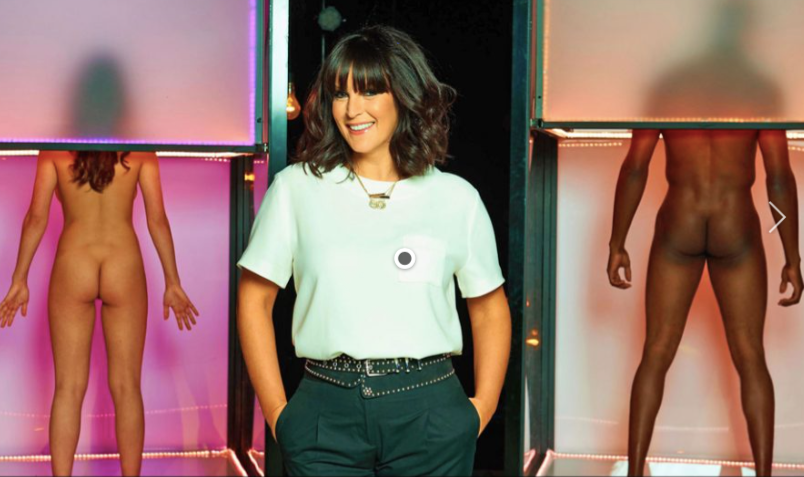
It is no wonder that we, as women, get sucked into these notions of ‘quick fix’ beauty solutions. Self-objectifiction is something that I think most women are guilty of and is a trait to be found in every group of women regardless of age, sexuality, race or ethnicity. These objectifications are what Sonia and I wish to explore and expose through our practical and research work. The message is – we all do it so let’s all stop! Women should give themselves a break, no-one is perfect and that’s ok. You only have to watch channel 4’s programme “Naked Attraction”to realise that!
Next Week
Continue work on section two.
Continue work on section three.

I have left the above picture here as we are still discussing the final part of the cycle, originally called Comfort in denial. The following are options for this part of the cycle which are all under discussion and scrutiny:
Comfort in discomfort
Strength in weakness
Beauty in pain
Freedom in oppression
Calm in the storm
Acceptance of the flaws
Bibliography
Ballou, H., 2013. PrettyFunny: Manifesting a normatively sexy female comic body. Comedy Studies, 4(2), pp. 179-187.
Beckett, S., 2010. Happy days. Main edition ed. London: Faber & Faber.
Ellemers, N., 2017. Gender Stereotypes, Utrecht: Annual Reviews.
Morry, M. M., 2001. Magazine Exposure: Internalization, Self-Objectification, Eating Attitudes, and Body Satisfaction in Male and Female University Students.. Canadian Journal of Behavioural Science, 33(4), pp. 269-279.
Reel, J., 2008. Age before beauty: an exploration of body image in African-American and Caucasian adult women. Journal of Gender Studies , 17(4), pp. 321-330.
SONIA: Getting concrete
This was such a full week, with searching around university for props, rehearsals and writing the script that my body decided it was too much excitement and made me rest in bed with fever. However that won’t stop me because this project is our baby and we are now in the final steps, so excitement is definitely in order!
I cannot believe it has been two months since we started our work in the studio! All of those experiments, readings and hours of overthinking are now being channelised into the structure of our performance. This past week was very exciting, not just because we got a lot of work done but especially because we had a lot of fun doing it!
Section 1
I was very keen on including recorded voice in our performance, not just because it’s something that I like but because I thought it could be an interesting way to explore and present our thoughts (Sarah’s make up rules and my thoughts on going to a social event). It allows a certain degree of intimacy. We decided to start the performance by exposing our anxieties and insecurities in a raw way, by combining the recording with light, darkness and some physical movements.
The script that we created has a lot of common points between both characters but we wanted to create a contrast between what they are doing on stage. Therefore Sarah will be lit all the time and putting make up on, while I will only be lit on specific and short moments. She will be facing the audience all the time while my face will never be visible. By doing this, we’re aiming to play with the idea of insecurity as not showing the face and putting make up on it, can both be perceived as hiding.
This was challenging from me because I’m used to rely a lot on my facial expressions when I’m acting. This also made me think a lot about the singer Sia’s. She often sings standing backwards to the audience, or this video where the dancers don’t have faces: (other videos (such as “Chandelier” or “the greatest” are also important for section 3 as well, because of the repetitive and mechanical movements).
Section 2
It is also important to us that we maintain one of our biggest assets, which we have since the beginning of our process, the highlight of our differences! We have been focusing on understanding more about each other and our will to respect the other person’s way of being has, sometimes, clouded our critical view on the point we are trying to make. For example, if someone else would explain to me all that make up procedure, beauty treatments, two different bikinis per day or that you cannot combine pink and red (that took her half an hour to make me understand it!), I would laugh and say those are ridiculous… but it’s Sarah. She explains it in a way that makes me agree with it, plus I want to understand why she puts herself through all that trouble.
Nevertheless, critiquing each other’s habits as a way to expose them seems important for the second part of our performance.
We will start with Sarah trying to help Sonia to relax and be more confident but without asking her if she wants that and giving pointless advice. For this we will focus on general tips to overcome anxiety founded on books or online and mindfulness (we created a character, the life coach Claire Morgan, and also a short mindfulness experience for Sarah and Sonia to interact with each other).
After being fed up with Sarah attempts, Sonia will subvert things and start pointing out Sarah’s insecurities, comparing her to the “10 beauty commandments” that we created. In this part we will use the celebrity masks, measuring tapes and the words about beauty we cut from magazines and the dictionary.
Section 3
Sarah has been very excited and bossy about this part (I love it!).
It’s amazing how she can, at the same time, listen to my insecurities and let me take the lead… so, by letting her take the lead on this section, I’m extremely excited to see what we can achieve with this! Why include a choreography here? By using the song “I can’t feel my face” by The weekend and start with some mechanic and repetitive movements, we are aiming to come back to the idea of “procedure” and repetition. We want to go back to our first dance piece together and showing different ways of stopping each other (that being a personification of our anxieties) but finishing with support and comfort. Our insecurities stop us from doing things but they also trap us with “sweet voices” saying that we need them.
I believe this section has a lot to do with the last part of our cycle that we called “comfort”… I’ve been thinking about this for a long time and trying to come up with a better way to describe this stage of the sequence. During a supervision on Thursday, Jo challenged that concept and I agree that is not correct, it also drives me insane that I cannot explain it properly!

???????
:
Comments